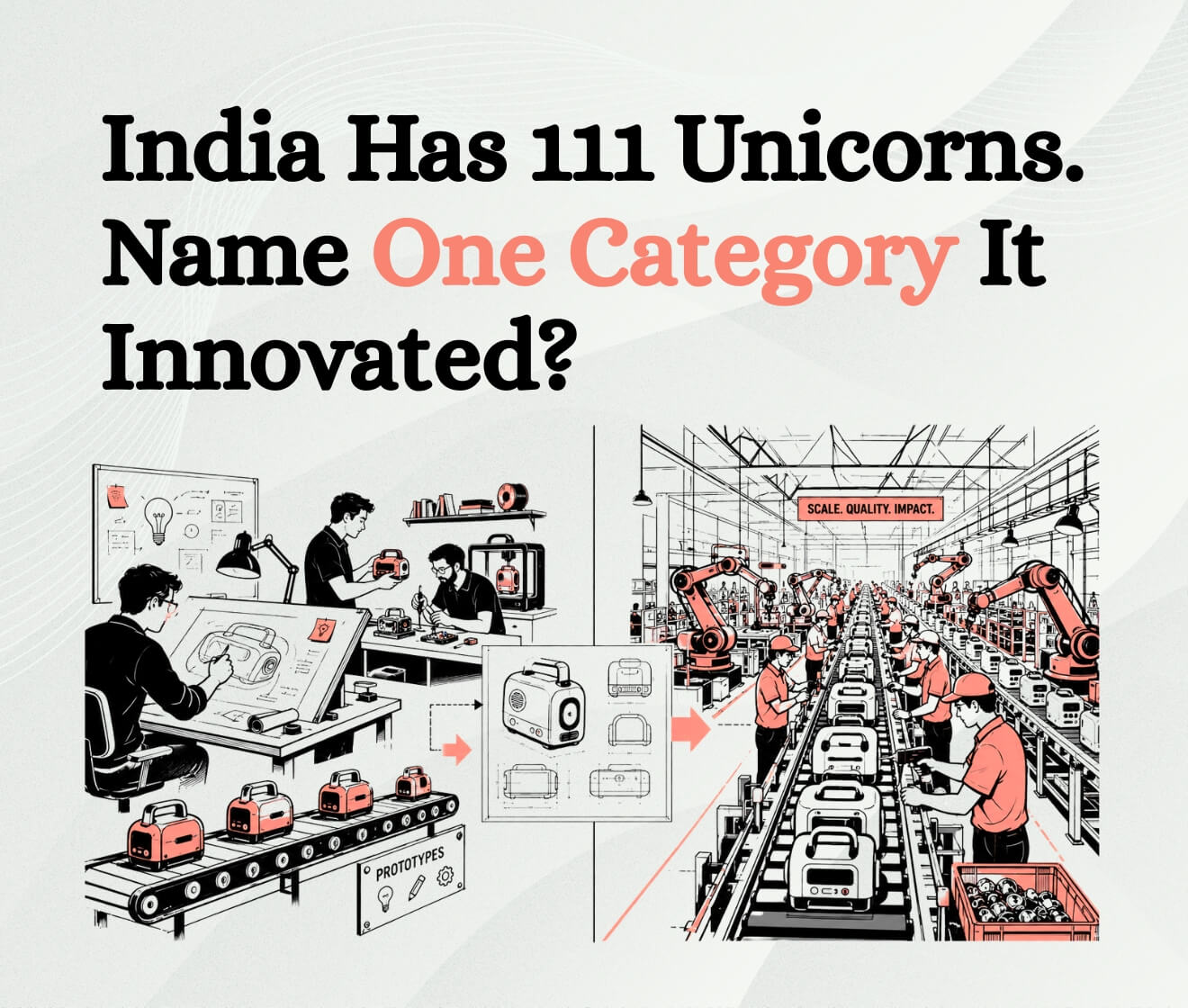
India has the third-largest startup ecosystem in the world by deal volume. It has also spent three decades building well-executed copies of ideas from San Francisco and Shenzhen. Those two facts are connected.
In 2011, Flipkart pitched itself as the Amazon of India. In 2015, Ola raised on the Uber of India thesis. In 2019, Meesho was Pinduoduo adapted for WhatsApp. In 2023, at least a dozen Indian founders raised seed rounds to build the ChatGPT of India.
The pitch structure never changed. Only the American or Chinese original did.
This is not a bug. For fifteen years it was a rational strategy: take a proven model, localize for Indian price points, build distribution across a fragmented market, and grow fast enough to attract capital before the original entered. It produced real companies, real employment, and real returns. Flipkart sold to Walmart for $16 billion. Nobody should pretend that execution at that scale is trivial.
But a renovation strategy has a hard ceiling. You can optimize someone else’s idea for decades. You cannot own a category you did not create. India, with 111 unicorns as of 2024, has produced almost no foundational technology that other markets adopted. Not one category-defining software product that started in India and spread outward. That gap is the honest accounting of three decades of renovation.
What Renovation Looks Like from the Inside
It does not arrive labeled as copying. It arrives as market research.
A founder notices that Salesforce charges $150 per seat per month and that India’s 63 million SMEs cannot afford that. They build a CRM at Rs. 499 per month with a WhatsApp integration layer, hire a 40-person inside sales team, and raise a Series A on the thesis that they are building the operating system for Indian SMEs. The underlying data model, the pipeline logic, the reporting structure — all inherited from Salesforce. The pricing and distribution channel changed.
This is what two decades of Indian B2B SaaS looks like. Freshworks is the clearest example: built on Zendesk’s category, priced for markets Zendesk ignored, grew to a $1.1 billion IPO in 2021. Legitimate business. Freshworks did not invent the helpdesk. It found the customers Zendesk left behind.
Here is the full pattern across consumer and enterprise:
| Indian Company | Original Model | Category | What India Adapted |
|---|---|---|---|
| Flipkart | Amazon (USA) | E-commerce | Cash on delivery, regional language support, lower price points |
| Ola | Uber (USA) | Ride-hailing | Auto-rickshaw integration, cash payments, tier-2 city expansion |
| Swiggy | DoorDash / Deliveroo (USA/UK) | Food delivery | Hyperlocal delivery, lower average order value, dark stores |
| Zomato | Yelp + GrubHub (USA) | Food discovery and delivery | Restaurant discovery layer added before delivery pivot |
| Meesho | Pinduoduo (China) | Social commerce | WhatsApp-based reseller network, rural women as distribution |
| Paytm | Alipay (China) | Digital payments | QR-based payments for street vendors, offline merchant network |
| Nykaa | Sephora + Glossier (USA) | Beauty e-commerce | D2C brand layer added on top of marketplace model |
| Urban Company | TaskRabbit / Handy (USA) | Home services marketplace | Trained service professional model for Indian household needs |
| Dunzo | Gopuff (USA) | Quick commerce | 10-minute delivery adapted for India’s kirana store density |
| Zepto | Getir (Turkey) | Quick commerce | Dark store model, 10-minute grocery in metro cities |
| BYJU’S | Coursera / Khan Academy (USA) | EdTech | Tablet-based learning, sales-heavy distribution, regional content |
| Unacademy | Udemy (USA) | Online learning | Live classes model, competitive exam focus, vernacular content |
| Razorpay | Stripe (USA) | Payment infrastructure | UPI integration, Indian compliance layer, SME-focused pricing |
| Groww | Robinhood (USA) | Retail investing | Zero-commission model adapted for Indian mutual funds and stocks |
| CureFit | Equinox + Peloton (USA) | Health and fitness | Offline fitness centers plus digital content, Indian diet focus |
| ShareChat | Twitter + Pinterest (USA) | Social media | Vernacular-first, tier-2 and tier-3 audience, regional language feeds |
| Lenskart | Warby Parker (USA) | Eyewear e-commerce | Home try-on model, offline store expansion, affordable pricing |
| Rapido | Lime / Bird (USA) | Bike taxi | Two-wheeler ride-hailing for congested Indian city traffic |
| Spinny | Carvana (USA) | Used car marketplace | Certified used cars with home delivery, Indian financing integration |
| Khatabook | Wave Accounting (Canada) | SME bookkeeping | Digitized the physical khata ledger kept by Indian shopkeepers |
A few earned their distinction. Meesho’s WhatsApp reseller network, built around rural women earning commissions on social sharing, was something Pinduoduo never built. Razorpay’s UPI integration is deeper than anything Stripe offers today. Khatabook digitized a tool — the physical credit ledger called a khata — that had existed in Indian kirana stores for over a century.
But the founding insight in every case originated elsewhere. India supplied engineering, distribution, and local market knowledge. The original idea was imported.
Three Reasons the Ecosystem Built This Way

Indian VCs priced out original ideas. For most of the 2010s, “it’s X for India” reduced due diligence from first principles to benchmarking. If Doordash was valued at 8x revenue, a comparable Indian food delivery company had a starting valuation reference. Original ideas with no comparable forced investors to build valuation models from scratch, assess unproven market sizes, and explain their thesis to LPs without a US exit to point to. The path of least resistance was funding the localization play. Peak XV (formerly Sequoia India), Accel, and Matrix Partners backed this approach repeatedly because it worked.
IIT and IIM produced solvers, not questioners. The JEE Advanced, which gates entry into IITs, tests a student’s ability to solve known problem types faster than 99.9% of their peers. That produces exceptional engineers. It does not produce people comfortable building toward an answer nobody has confirmed exists. The skill of sitting with a genuinely open problem, without an answer key, without a benchmark, without a comparable, is not what India’s most competitive educational pipeline selects for.

Failure carried family-scale consequences. A Y Combinator partner in San Francisco will tell a founder that a failed startup is table stakes for the next round. In a Punjabi household in Ludhiana, or a Tamil Brahmin family in Chennai, a son or daughter who shut down a company after burning three years and someone else’s capital faces a conversation that does not end. Until the Flipkart and Ola generation normalized startup careers, the social cost of an original bet gone wrong was higher than the social cost of running a safe execution that missed its Series B.
Where India Actually Invented Something
UPI is the clearest counterexample. The National Payments Corporation of India built a real-time interoperable payments rail that the US Federal Reserve spent a decade trying to replicate with FedNow, launched in 2023 and still not at UPI’s adoption scale. Singapore’s PayNow, France’s Virement Instantané, and payment infrastructure across Ghana, Namibia, and Sri Lanka all studied UPI. This is Indian-origin technology that other countries are now renovating.
Aadhaar, whatever its civil liberties debates, is a biometric identity infrastructure at 1.4 billion users that no comparable democracy had built before. The World Bank has studied it as a model for national ID systems in Kenya, Morocco, and the Philippines.

The uncomfortable fact: both came from government-mandated institutions with ten-year time horizons and no fund return requirements. The private VC ecosystem, operating on seven-year fund cycles with deployment pressure in year two and markup expectations by year four, did not produce either of these. Patient capital and original technology are not coincidental companions.
What the Next Decade Actually Requires
India has three structural advantages that renovation cannot leverage.
Scale as a problem generator. No Western market has had to solve cold chain logistics at sub-$2 margins across 640,000 villages. No Western market has had to deliver healthcare in districts where the patient-to-doctor ratio is 10,000 to 1. No Western market has had to build agricultural credit for 150 million farmers with zero formal financial history. These are problems that, if solved, produce technology that every emerging market from Indonesia to Nigeria will pay to use. The company that cracks rural credit underwriting in India will not be building the Lending Club of India. It will be building something Lending Club studies.
A returning diaspora with research credentials. Sarvam AI, the Bangalore-based LLM company building foundational models for Indian languages, was founded by Vivek Raghunathan and Pratyush Kumar, both former researchers at AI4Bharat and international ML institutions. They came back. Krutrim, founded by Bhavish Aggarwal after building Ola, is training its own LLM stack rather than fine-tuning an existing one. These are small signals. The cohort of India-origin researchers who did foundational work at DeepMind, Google Brain, and Meta AI and are now considering returning is larger than at any point in the last twenty years.
An 18-month window in foundation model research. Open-source model weights from Meta (LLaMA 3), Mistral, and others have temporarily democratized access to foundational AI research. A team of eight researchers in Bangalore with strong compute access can run experiments that would have required a Google Research affiliation in 2019. That window will narrow as frontier model training costs increase and compute concentrates back in a handful of hyperscaler clusters. India has not moved with urgency on this. The IITs have research groups. They do not have the funding structures, the equity incentives, or the industry partnerships to retain the researchers long enough to produce foundational work.
The Capital Structure Problem
None of the above happens inside a ten-year fund with a two-year deployment window.
Foundational research takes three to five years to produce a product. That product takes another three years to find a market. An Indian VC raising a Rs. 2,000 crore fund in 2024 with LP expectations of a 3x return by 2031 cannot rationally back a team spending year one and two doing pure research. The math does not work.
India needs fund structures with twelve-to-fifteen year horizons, corporate R&D budgets that produce patents rather than just headcount, and family office capital that can absorb a seven-year pre-revenue period. The government’s Rs. 1,000 crore deep tech fund announced in the 2023 union budget is a start. NASSCOM’s AI research initiatives have produced papers. Neither is at the scale the opportunity requires.
The Trade-off Nobody Wants to Name
Indian founders face a concrete choice that ecosystem cheerleading obscures.
Build a localization play: raise a seed round in six months with a US comparable in the deck, reach Series A in eighteen months if execution holds, potentially exit to a strategic in year seven. Proven path. Multiple data points.
Build something original: spend twelve to eighteen months convincing investors that the category exists, raise a smaller seed at a lower valuation, operate for three to five years before the market validates the thesis, face the possibility that the thesis is wrong with no pivot to a comparable.
Most founders, rationally, choose the first path. The second path requires either a founder wealthy enough to absorb the personal financial risk of a longer runway, or a capital market willing to price and fund original bets at the same velocity it funds localization plays. India currently has neither in sufficient quantity.

That is the actual constraint. Changing it requires fund structure reform, not founder inspiration.
This essay is part of an ongoing series on growth, technology, and what it means to build. Read more on my blog.
About Author