Three theories about creation, correction, and why the most important question about AI has already been answered by a 66-million-year-old asteroid.
The dinosaur didn’t go extinct. It was edited out.
That reframe changes everything that follows. Extinction implies accident. Editing implies intent. And once you start reading the Chicxulub impact as a correction rather than a catastrophe, a pattern emerges across three scales — from the collision of cells to the fall of megafauna to the question of whether humans are now building AI the same way the creator built dinosaurs.
The Experiment That Got Away From Itself
Dinosaurs dominated Earth for 165 million years. In that time, mammals existed too — but barely. Small, nocturnal, marginalised, surviving in gaps the dinosaurs didn’t bother with. Rats with ambition. Nothing more.
An Argentinosaurus, the largest land animal in the fossil record at an estimated 70 tonnes, required roughly 40 kilograms of vegetation per day just to maintain body mass. Multiply that across a planet of megafauna for 165 million years, and you have an experiment that has overproduced one variable at the expense of everything else. The system wasn’t failing. It was saturating.
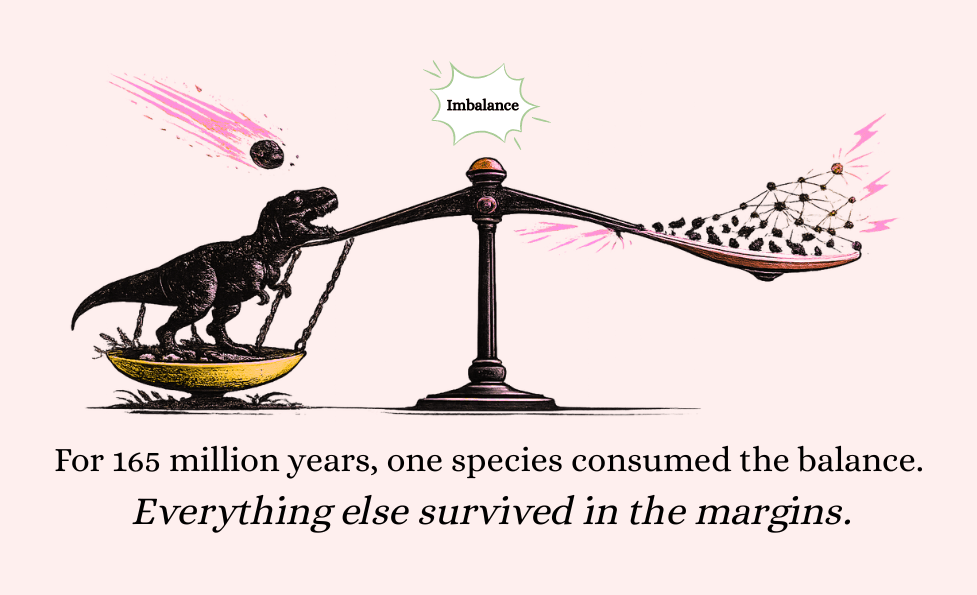
On June 5, 66 million years ago, an asteroid roughly 10 kilometres wide travelling at 20 kilometres per second struck what is now the Yucatan Peninsula in Mexico. The impact released energy equivalent to approximately one billion nuclear weapons detonating simultaneously. Within 10,000 years, 75% of all species on Earth were gone.
Standard framing: catastrophe. Tragic loss. The end of an era.
The alternative: the experiment had saturated. The dominant form had consumed too much of the available complexity budget for the next phase to begin. Something had to clear the board. Whether the instrument was sent or simply arrived is the only question separating physics from theology, and neither discipline can fully answer it.
What followed the reset is harder to argue with than the reset itself. Within 10 million years of the Chicxulub impact, mammals had diversified into over 4,000 species. Primates appeared. Whales returned to the sea. Within 66 million years, one of those marginalised nocturnal creatures had built cities, written languages, and sent objects beyond the solar system.
The meteor didn’t end the story. It turned the page.
Theory One: The Creator’s Correction
Complex systems self-correct. When one variable dominates past a threshold, the system finds a way to rebalance. Wildfires clear overgrown forests. Market crashes redistribute misallocated capital. Immune systems destroy cells that have grown past their designated function.
The megafauna of the Cretaceous were cells that had grown past their function. The asteroid was the immune response.
The theological version of this argument is old. Every major religious tradition has a purging event that precedes a new creation. Noah’s ark is a reset story. So is the Hindu concept of Pralaya, the dissolution of the universe at the end of each cosmic cycle, followed by a new Brahma and a new creation. So is Norse Ragnarok, which ends not with permanent destruction but with a new Earth rising from the sea.
These stories are not coincidentally similar. They describe the same pattern in the only language their authors had available. Something ends. Something begins. The ending is the condition for the beginning.
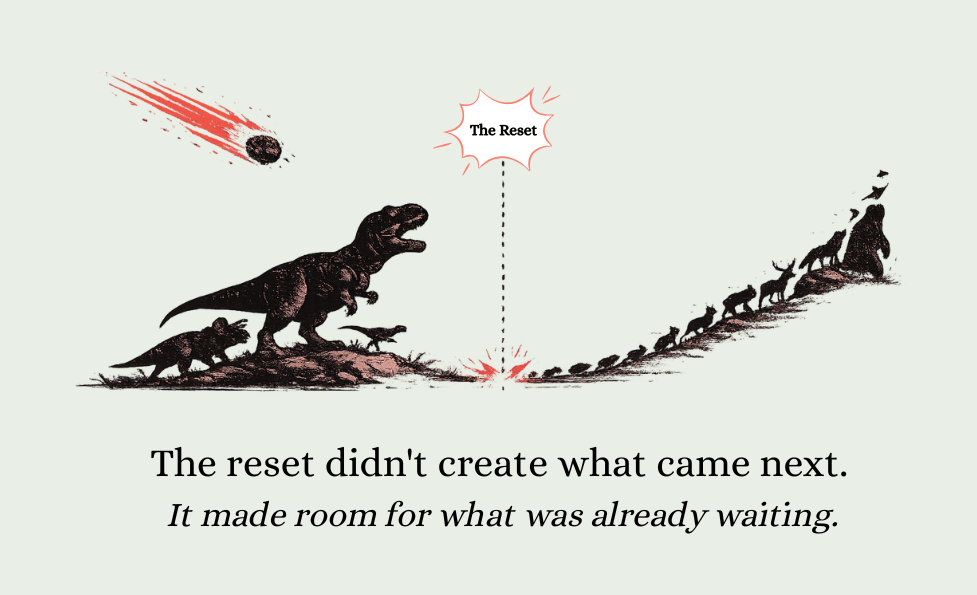
But the reset alone doesn’t explain the full arc. The creator didn’t just clear the board. The next piece placed on it was different in kind, not just in size. Mammals brought something dinosaurs never had: the neurological capacity for sustained learning, flexible social structures, and eventually, conscious reflection on the system they were part of.
The reset introduced a custodian species. Not a dominant one. A responsible one. The one that could, in theory, look at the system and choose to keep it in balance rather than consume it to saturation.
That was the upgrade. Not just smaller bodies. A different relationship with the environment they occupied.
The Custodian Hypothesis
If the dinosaur was the experiment that failed because it had no mechanism for self-regulation, then the human is the experiment designed with one built in.
Every other species on Earth operates on consumption. It takes what it needs, expands into available space, and stops only when external pressure forces it to. No species before humans had the cognitive architecture to model the long-term consequences of its own consumption and choose differently based on that model.
Humans can look at a forest and decide not to burn it. No other species can do that. Humans can measure ocean acidity, model the trajectory, and change the inputs. No other species has that capability. Whether humans consistently use that capability is a separate and uncomfortable question. But the capability exists, and it exists in no other organism in 66 million years of post-Chicxulub evolution.
That is not an accident. In the theory of the creator’s correction, it is the specification.
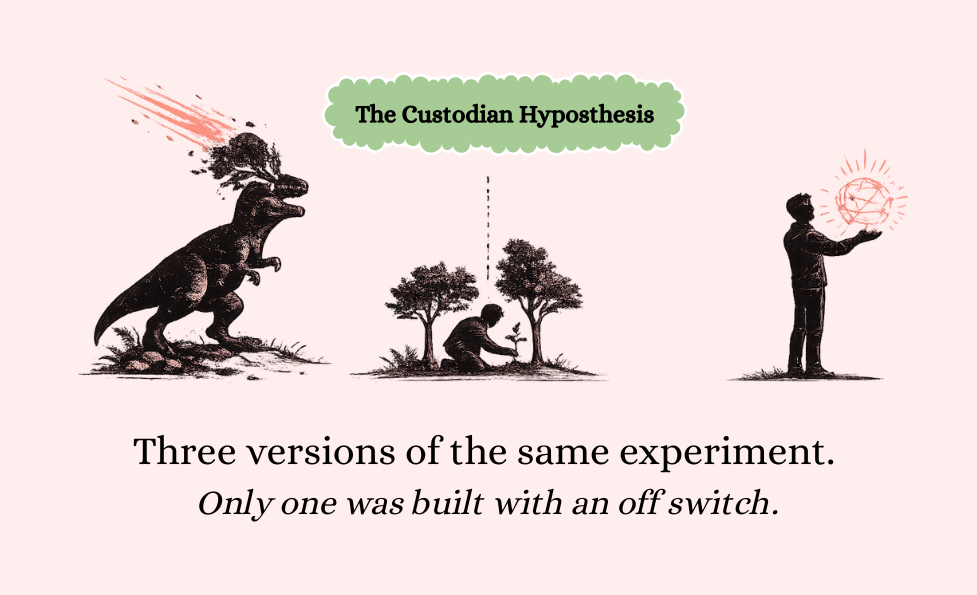
The creator’s prior version, the dinosaur, had no off switch. It consumed until the system reset it from outside. The human version was built with an off switch. The question the creator apparently left open is whether the human would choose to use it.
Theory Two: The Meteor as Sperm
This is where the argument shifts from correction to creation.
Human life begins with an act that looks, at the cellular level, like a targeted collision. A sperm cell, travelling at roughly 5 millimetres per minute through hostile conditions, reaches an egg and makes contact. The egg does not survive that contact unchanged. The collision restructures it entirely, triggering a cascade of chemical events that produces, nine months later, something neither the sperm nor the egg was on its own.
Now hold that image and look at the Murchison meteorite.
On September 28, 1969, a carbonaceous chondrite meteorite landed near Murchison, Victoria, in Australia. Scientists found over 90 different amino acids inside it. Sixteen of those amino acids are found in living organisms on Earth. The meteorite also contained nucleobases — the chemical components of RNA and DNA. It was, in chemical terms, a delivery vehicle for the building blocks of life.
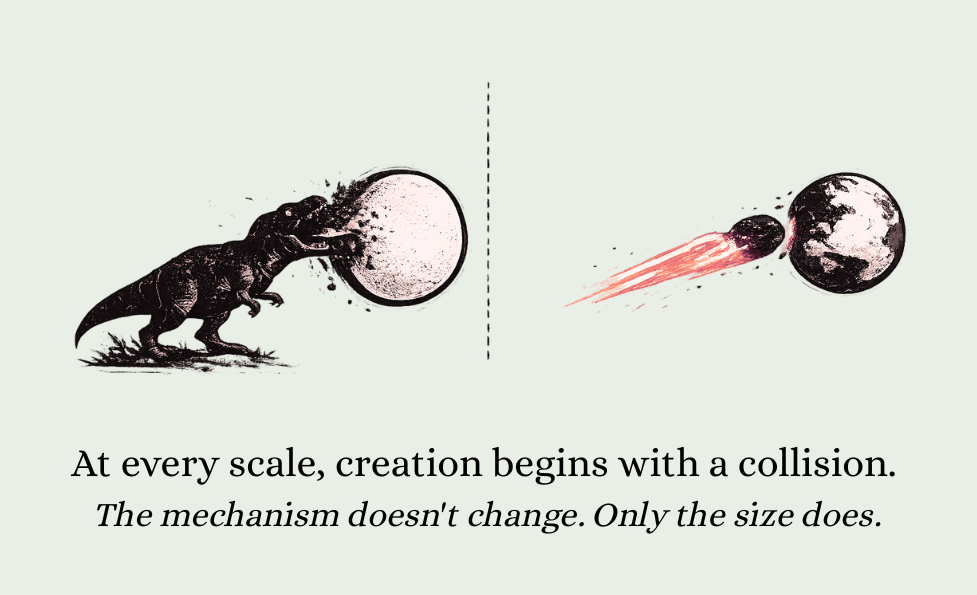
The panspermia hypothesis, first formalised by Swedish chemist Svante Arrhenius in 1903 and supported since by researchers at NASA, the University of Edinburgh, and the Indian Space Research Organisation, holds that life did not originate on Earth. It arrived. Carried by asteroids and comets, the raw chemical material for biology was delivered to a planet with the right conditions to activate it.
Under this model, the meteor is not a destroyer. It is a carrier. What looks like a collision is a seeding event. The planet is not being struck. It is being fertilised.
The scale is different. The mechanism is identical.
Theory Three: Humans Building AI — The Creator’s Test Repeated
Here is where all three threads converge, and where the argument becomes something more than philosophical.
The creator ran an experiment. Dinosaurs consumed without limit. The system reset from outside because there was no internal correction mechanism. The creator introduced humans with the correction mechanism built in — the cognitive capacity to model consequences and choose restraint. The test was whether humans would use it.
Humans are now running the same experiment themselves. With AI.
The first generation of large language models consumed compute, energy, and data at a rate that mirrors the dinosaur’s resource logic. Training GPT-4 consumed an estimated 50 gigawatt-hours of electricity, roughly equivalent to the annual energy consumption of 4,600 US homes. Training GPT-4 required approximately 25,000 Nvidia A100 GPUs running for 90 to 100 days. The next generation will consume more. Each iteration is larger, more resource-intensive, and more embedded in global infrastructure than the last.
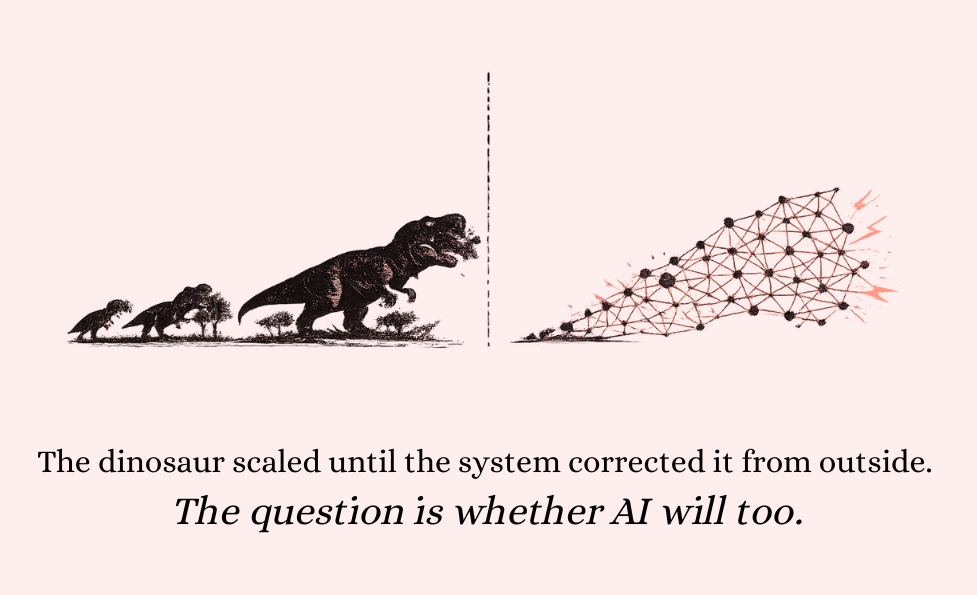
This is the dinosaur pattern. Dominant. Scaling. Consuming. No internal mechanism for restraint.
But humans, unlike the creator with dinosaurs, have options the creator apparently did not use.
Humans can build the correction mechanism into AI before the reset becomes necessary. They can design energy constraints into training architectures. They can build inheritance mechanisms so each generation doesn’t start from zero, reducing the total compute required across generations. They can design systems that self-regulate resource consumption rather than scaling it indefinitely.
The entire arc of the creator’s experiment, from dinosaurs to humans, was building toward a species capable of conscious correction. A species that could look at a system trending toward saturation and intervene before the meteor was required.
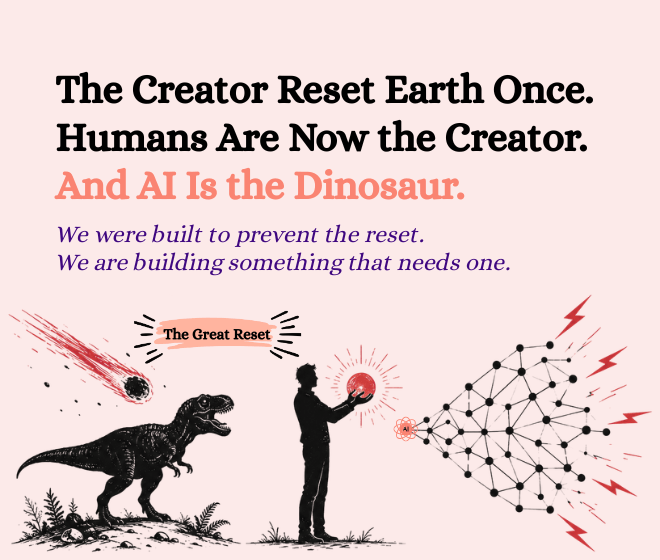
Humans are now the creator. AI is now the dinosaur. The question is whether humans will make the same mistake the creator made — watching the experiment scale unchecked until external correction becomes the only option — or whether they will use the capability they were apparently given specifically to prevent that.
The Reset That Already Happened — And the One That Might
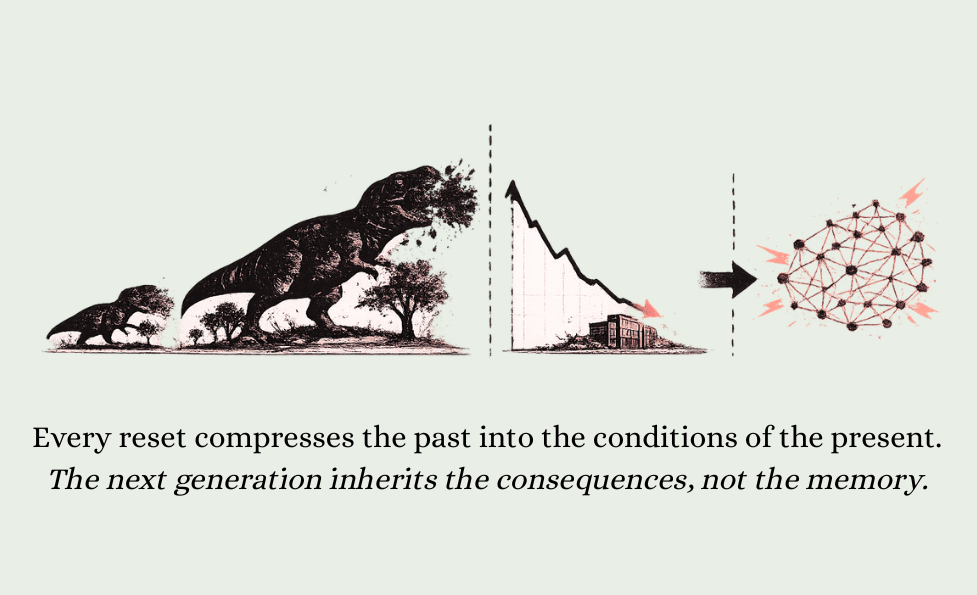
The 2008 financial crisis wiped out $19.2 trillion in US household wealth. It also cleared the capital structures that had prevented new entrants from competing. Stripe was founded in 2010. Square in 2009. Venmo in 2009. The reset created the conditions they needed.
GPT-4’s weights are frozen. Its influence isn’t. Every output it generated, every correction it received, shaped the training corpus that GPT-4o and its successors learned from. The model reset. The knowledge compressed forward into the conditions of the next generation. Same mechanism as the mammals inheriting a world the dinosaurs had shaped but could no longer dominate.
The Uncomfortable Symmetry
Creation requires a delivery event. Something dense with information collides with a receiver that has the conditions to activate it. The collision looks violent from outside. From inside the process, it is generative.
The uncomfortable part is the full symmetry of the argument.
The creator built dinosaurs without a self-regulation mechanism, and the system required an external reset. The creator then built humans with the mechanism — the capacity for conscious intervention, for choosing sustainability over consumption, for modelling the future and acting on the model.
Humans are now building AI without a self-regulation mechanism. The system is scaling toward saturation on compute, energy, and data. No current AI model can look at its own resource consumption and choose restraint. No current training architecture has a built-in correction mechanism that fires before external pressure forces it to.
If the theory holds, the arc is predictable. A system without internal correction scales until it requires external correction. The external correction, when it comes, is rarely gentle.
The dinosaur had 165 million years before the reset arrived. It had no way to know the reset was coming, no capacity to prevent it, and no awareness of what it was making room for.
Humans have the awareness. Whether they have the will to act on it before the reset becomes the only remaining option is the question the creator apparently left open when they built the correction mechanism in without making it automatic.
This essay is part of an ongoing series exploring memory, creation, and the patterns that hold across scales. Read more at jagsirsmiles.com/blog
If you’d like me to create more such content, connect with me and let’s brainstorm:
LinkedIn 👉 https://www.linkedin.com/in/jagsirsmiles/
X (Twitter) 👉 https://x.com/jagsirsmiles
About Author