“I posted my story on social media hoping everybody would help me. Nobody did.”
That sentence is doing more work than it appears to. It is not just about one person’s disappointment. It is a precise description of what happens when fraud erodes a society’s ability to respond to real pain. Every fake cancer campaign, every fabricated accident story, every crowdfunding page that turned out to be a scam deposits a small amount of cynicism into the public pool. By now the pool is deep enough that a 24-year-old farmer’s son with two failed kidneys cannot get a stranger to click share.
The frauds win twice. Once when they take the money. Again when their actions make it impossible for the next genuine person to be believed.
Ajay Kumar Banjare
I met Ajay at Ramakrishna Care Hospital in Raipur. He was 24. His kidneys had failed four years earlier, when he was 20. Both of them. He has been on dialysis twice a week since then, which costs his family Rs. 4,200 every week. His father is a farmer feeding a family of eight on whatever the land produces.
Ajay travels 200 kilometres alone to get to that hospital. Each way. He does this twice a week.
He sleeps two hours a day. He told me this without complaint, the way you state a fact about weather. He was awake with me the entire night I was there. At some point I stopped feeling tired on his behalf and just watched him.
Anaesthetics do not work properly on his body. The dialysis needles go in. He feels it. He endures it. Then he goes back to making the elderly patients in the ward laugh.
The whole hospital calls him the sleepless ghost.
The Number That Ended His Hope
His doctors told him that treating the Hepatitis C infection in his liver, then doing the kidney transplant, would cost Rs. 12 to 13 lakh. He cannot get the transplant without treating the liver first. He cannot treat the liver without the money. The number sits at the end of every option like a locked door.
He knows his medical condition means he will not live more than ten years.
He told me this, and then he said he sometimes feels low watching his friends post about their evenings out. He said it the way you might mention a minor inconvenience, a longer commute, a cancelled plan. His face did not change.
Before every dialysis session, he stops at a charitable trust to collect a coupon that funds 80% of the cost. Then he goes to the hospital. He has built a logistics system around his own survival. Every week. Alone. 200 kilometres each way.
If he lives longer and healthier, he told me, he wants to help more people laugh.
What We Have Trained Ourselves to Do
The instinct, when you read something like this, is to verify. To look for the catch. To ask whether the numbers add up, whether the photos are real, whether someone is being played.
That instinct is rational. It was trained into us by people who deserved the suspicion. It has now spread to people who do not.
The problem is not that we became sceptical. The problem is that we applied blanket scepticism instead of building better tools for distinguishing real from false. A doctor’s file, a hospital registration number, a dialysis record, these are verifiable. They take twenty minutes to confirm. Most people do not confirm. They scroll past.
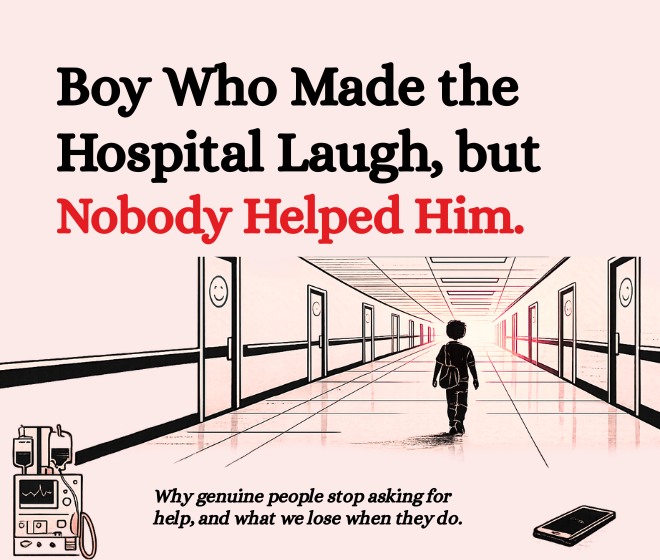
Why genuine people stop asking for help, and what we lose when they do.
Genuine people like Ajay, who have no marketing budget, no viral hook, no professional photographer following them around the ward, disappear in the feed. The polished fraud, with a well-lit photo and an emotionally calibrated caption, stays visible.
We have accidentally built a system that rewards performance and punishes authenticity.
The Call That Never Went Through
Some time after I met Ajay, when I was in a better financial position, I called him.
His phone was dead.
He never answered.
I do not know what that means. I have thought about it more than I expected to. Maybe he got the transplant and moved on. Maybe his number changed. Maybe the ten years shortened. I do not know which of those is true, and I am aware that the not knowing is a small and manageable discomfort compared to what he lived with every Tuesday and Friday on that 200-kilometre road.
What I know is that there was a window. It closed. And I cannot tell you whether it closed because I waited too long or because the world simply ran out of time for him before either of us could do anything about it.
Stop helping people and you will never have to sit with that question. Keep helping and you will sit with it sometimes.
I think sitting with it is the right trade.
This essay is part of an ongoing series on what it means to be human. Read more at jagsirsmiles.com/humanity
If you’d like me to create more such content, connect with me and let’s brainstorm:
LinkedIn 👉 https://www.linkedin.com/in/jagsirsmiles/
X (Twitter) 👉 https://x.com/jagsirsmiles
Substack 👉 https://jagsir.substack.com/
About Author