Every founder and marketer faces the same frustrating paradox.
You have something genuinely valuable to offer, but you can’t seem to break through.
You run ads. You write posts. You send emails.
And somehow, it still feels like shouting into the void.
The problem isn’t your product.
It’s your message.
In a world where everyone is talking, clarity wins.
That’s why I built the SCRD Framework, a system for writing marketing messages that get attention, build trust, and move people to act.
Why Marketing Needs a New Playbook
Older models like AIDA (Attention, Interest, Desire, Action) still describe what happens in the buyer journey.
But they don’t explain how to emotionally move someone through that journey.
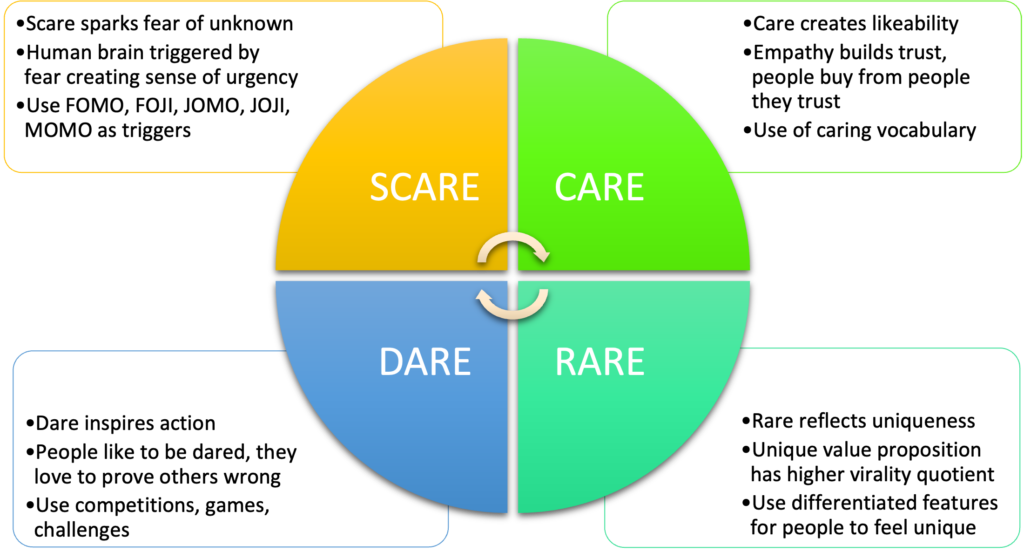
That’s where SCRD — Scare, Care, Rare, Dare — fits in.
It’s not just a framework. It’s a pattern of human behavior.
People act when they feel urgency, empathy, uniqueness, and momentum.
The SCRD Framework
| Stage | What It Means | Goal |
|---|---|---|
| Scare | Show the real cost of inaction | Get attention |
| Care | Show empathy and understanding | Build trust |
| Rare | Show what makes you different | Build desire |
| Dare | Challenge or inspire to act | Create action |
Each stage aligns with how people actually decide, emotionally first and rationally later.
Let’s Break It Down
1. S — Scare: The wake-up moment
People don’t move because you tell them to.
They move because they realize standing still has a cost.
Example (Cybersecurity):
“Your business doesn’t get hacked because of bad tools. It gets hacked because your teams don’t agree on what ‘secure’ means.”
That’s not fearmongering. It’s awakening.
The goal isn’t panic. It’s perspective. You’re helping the audience confront a truth they’ve ignored.
Example (SaaS/Operations):
“You don’t lose deals because of bad salespeople. You lose them because your teams don’t see the same data.”
That one line reframes the problem. It moves the conversation from symptom to root cause.
2. C — Care: The trust bridge
Once you’ve earned attention, show that you understand their world.
This is where empathy meets credibility.
Example (Cybersecurity):
“We’ve worked with dozens of SOC leaders who know what chaos looks like: too many alerts, too little time, too much pressure.”
Example (HR Tech):
“Every HR leader wants performance reviews that don’t feel like punishment. You’re not alone in trying to make them better.”
This is where your audience feels seen. And when people feel understood, they stop resisting your message.
3. R — Rare: The shift from empathy to authority
Now that your audience believes you understand them, it’s time to show what makes you worth listening to.
This is your differentiator, your uncommon advantage, your “why us.”
Example (B2B SaaS):
“While most platforms track activity, we measure alignment. Because performance without alignment is just noise.”
Example (Cybersecurity):
“Most vendors sell tools. We build clarity, visibility that turns chaos into control.”
In short, Rare means why you are the one who can fix it.
4. D — Dare: The moment of courage
Every message needs a climax, a moment where you invite your audience to act.
This isn’t a call to action. It’s a call to courage.
Example (Cybersecurity):
“Stop waiting for the next breach to justify your next budget. Take the first proactive step today.”
Example (Startup Marketing):
“You’ve built the product. Now build the story. Start with your next post.”
The Dare stage works because people want to feel bold, not sold.
It reframes action as empowerment.
SCRD in Action: Real Use Cases
Use Case 1: A Cybersecurity Startup Trying to Sell to CISOs
Goal: Build trust and urgency without hype.
- Scare: “Most CISOs discover visibility gaps only after a breach.”
- Care: “We’ve seen the same pattern across 100+ SOCs: smart people, disconnected data.”
- Rare: “Our AI platform unifies detection and context so you can act faster.”
- Dare: “Don’t wait for the next incident report. Build visibility today.”
This sequence hits all four human triggers: urgency, empathy, differentiation, and momentum.
Use Case 2: A SaaS Platform Launching a New Feature
Goal: Get adoption without feature fatigue.
- Scare: “Most teams never use 70% of the tools they buy.”
- Care: “That’s not laziness. It’s because features get launched without stories.”
- Rare: “We built one that your users actually understand because it mirrors how they already work.”
- Dare: “Try it for a week and see if your workflow gets simpler, not heavier.”
Use Case 3: A B2B Marketing Agency (like NoirDove) Pitching to Founders
Goal: Show thought leadership and differentiation.
- Scare: “Most startups don’t die because of bad products. They die because nobody knows how to talk about them.”
- Care: “We’ve been in those rooms, great founders lost in their own message.”
- Rare: “That’s why we build GTM engines, not campaigns.”
- Dare: “If your story doesn’t scale yet, let’s rebuild it.”
Use Case 4: A Consumer Brand Selling Sustainability
Goal: Inspire behavior change without guilt.
- Scare: “The planet isn’t dying because of one big choice. It’s dying from millions of small ones.”
- Care: “We’re not perfect either. But we’re trying, and so are you.”
- Rare: “Our packaging is 100% biodegradable, designed to return to the earth.”
- Dare: “Join the next 10,000 customers choosing better habits this month.”
Why SCRD Works Everywhere
SCRD works because it doesn’t depend on your industry.
It depends on how humans think and decide.
People don’t act when they understand something.
They act when they feel something.
SCRD builds that emotional sequence, from awareness to action, inside every message you write.
How to Use It Today
- Take your current landing page or LinkedIn post.
- Map each paragraph to one of the SCRD elements.
- See which one you’re missing.
- Add it.
You’ll feel the difference immediately in engagement, clarity, and conversions.
Final Thought
Most marketing frameworks explain logic.
SCRD explains emotion.
It’s not about making your campaigns louder.
It’s about making them land.
Because clarity is not just what you say.
It’s how you make people feel before they decide.